In most environments, security systems are designed to work under controlled assumptions, with clear procedures, defined roles, and predictable responses. On paper, everything aligns.
In reality, things rarely unfold that way.
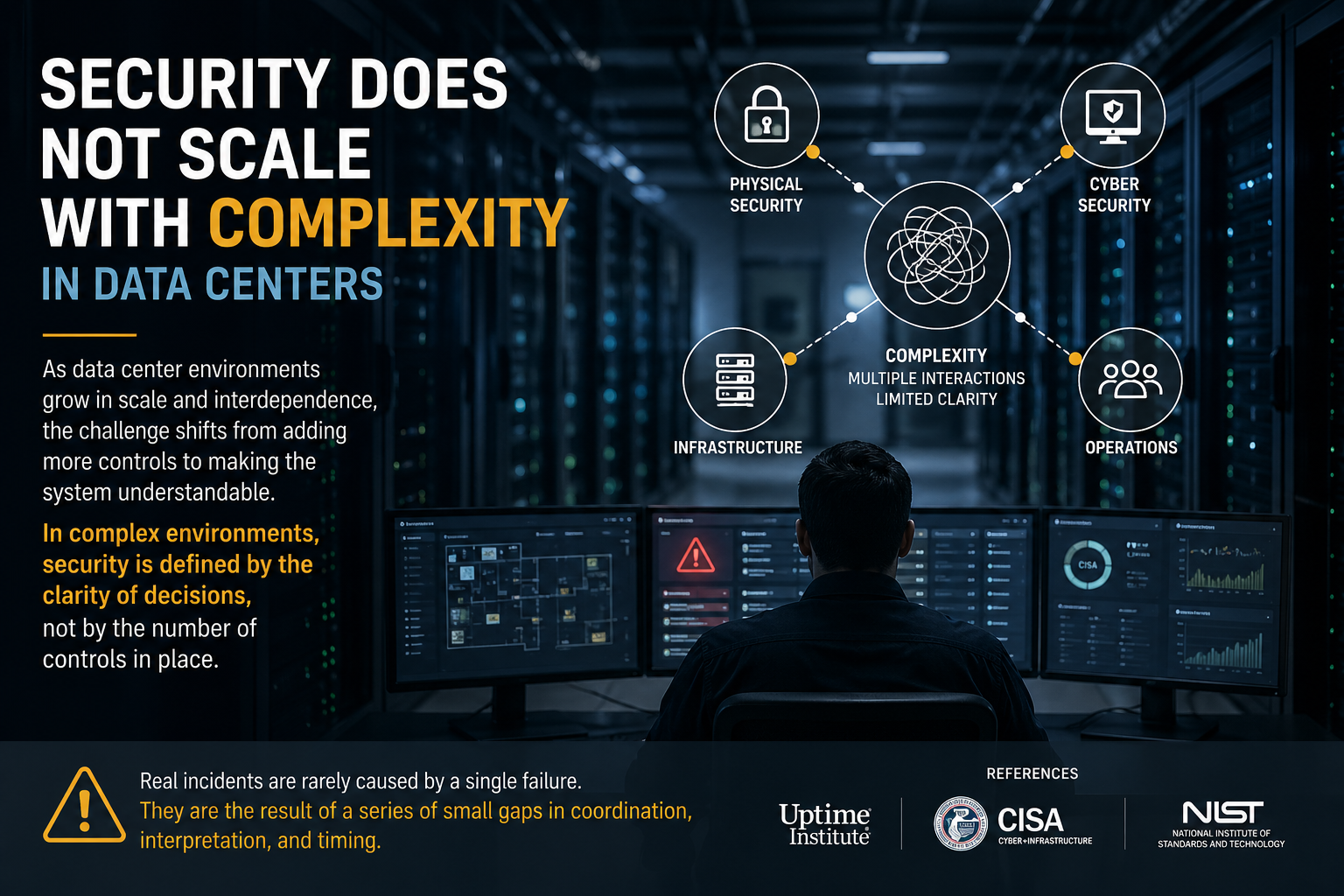
As complexity increases, systems stop behaving as they were originally designed. Multiple variables begin to interact simultaneously, and dependencies emerge between domains that were never meant to overlap. Decision-making becomes compressed, and the margin for error narrows. This is where the gap begins to appear.
Security design tends to assume stability, but operations rarely are.
A system can be technically sound, compliant, and fully aligned with best practices, yet still struggle when exposed to real operational pressure. Not because the controls are wrong, but because the environment is no longer predictable.
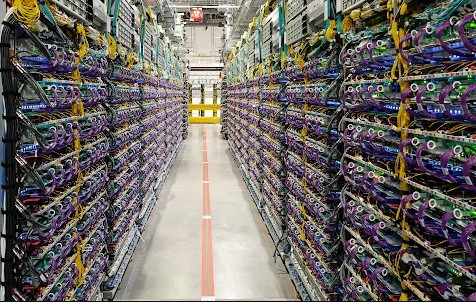
This becomes particularly visible in data center environments. These are not just protected buildings, but tightly interconnected systems where physical security, cyber infrastructure, environmental controls, and operational processes all run in parallel. Access control depends on network availability, monitoring depends on power stability, and response depends on coordination across multiple teams.
Industry reports such as the Uptime Institute Global Data Center Survey have repeatedly highlighted that operational complexity and human factors are among the leading contributors to incidents, rather than purely technical failures. Similarly, findings from Verizon’s Data Breach Investigations Report show that many security events involve multiple overlapping factors rather than a single point of failure.
When everything is working, this integration remains invisible. When something shifts, the interdependencies become exposed.
A small disruption, a delayed decision, or a misalignment between teams can escalate faster than expected, not because of a single failure, but because multiple parts of the system react simultaneously.
The issue is not the individual component. It is how the system behaves as a whole.
Most traditional approaches focus on strengthening individual layers, such as improving access control, enhancing surveillance, or refining procedures. While necessary, these measures assume that each layer operates independently.
In reality, layers interact.
When pressure increases, these interactions become the dominant factor. Decisions are no longer made in isolation, but are influenced by incomplete information, time constraints, and the behavior of other systems running in parallel.
At that point, performance is not defined by design, but by adaptation.
This is where many security models fall short. They are optimized for control, not for dynamic behavior.
Bridging this gap requires a shift in perspective. Instead of asking whether a system is correctly designed, the more relevant question becomes how it behaves when conditions change, how quickly it can adapt, how decisions propagate across the system, and what happens when multiple variables shift at once.
These are not theoretical questions. They define performance in real scenarios.
Understanding security as a static structure is no longer sufficient. It must be approached as a dynamic system, one that evolves under pressure and whose behavior cannot always be predicted from its design alone.
In environments such as data centers, where uptime, resilience, and coordination are critical, this gap is not just conceptual. It is operational.
Organizations that recognize it are better prepared to operate within it. Those that do not often discover it when it is already too late.