The conversation around attacks against data centers has shifted considerably over the past several years. For decades, data center security discussions largely focused on cyber intrusion, insider threat, operational resilience, and perimeter protection. Today, a broader and more uncomfortable reality is beginning to emerge. As hyperscale infrastructure expands and artificial intelligence accelerates demand for compute capacity, data centers are increasingly being viewed as strategic infrastructure assets tied directly to economics, energy, politics, and social stability. That evolution changes the threat landscape significantly.
This article was inspired by a recent discussion and research references shared by Luca Oleastri, whose observations surrounding AI infrastructure, geopolitical instability, and the social dimensions of data center risk highlighted how rapidly the conversation around infrastructure protection is evolving.
Recent discussions within security, intelligence, and infrastructure circles have centered on whether data centers and AI infrastructure could become targets for physical disruption, sabotage, or politically motivated attacks. While there are currently no credible intelligence reports identifying a specific timeline for coordinated attacks against the sector, a growing body of analysis is examining the conditions that could increase the probability of such incidents occurring. The distinction matters. Security professionals assess trajectories, vulnerabilities, and environmental conditions rather than predict exact dates.
One of the more notable observations comes from Mark A. Houpt, Chief Information Security Officer for DataBank, who warned in a recent forecast analysis that opposition to large-scale infrastructure projects may increasingly evolve beyond political resistance and enter the realm of physical risk. His assessment reflects a broader concern developing across the industry: the relationship between hyperscale expansion and local community response is becoming more strained as AI-driven infrastructure growth accelerates. Energy consumption, water usage, land acquisition, environmental impact, and the perception that communities are excluded from decision-making are all contributing to rising tensions in some regions.
The significance of this trend cannot be understated. Historically, critical infrastructure operators often viewed community opposition primarily through the lens of public relations or permitting challenges. Increasingly, however, security leaders are recognizing that public frustration can become part of the operational risk environment itself. Once infrastructure becomes associated with economic displacement, environmental stress, or unequal access to resources, the facility may begin to take on symbolic meaning beyond its technical function. In those cases, the data center is no longer perceived simply as a warehouse of servers. It becomes a visible representation of larger societal tensions surrounding technology, governance, globalization, and artificial intelligence.
This concern is not purely theoretical. Geopolitical conflicts have already demonstrated that digital infrastructure can become part of the physical battlespace. Analysts from the Foundation for Defense of Democracies (FDD), along with reporting from Euronews and regional security experts, have discussed incidents affecting infrastructure connected to cloud and AI operations in conflict-prone regions. While many of these events remain tied to broader regional instability and asymmetrical warfare, they reinforce a growing reality: infrastructure supporting AI, cloud computing, and national digital capacity may increasingly be viewed as strategic targets during periods of conflict.
The modern data center occupies a unique position within critical infrastructure. It supports financial systems, communications, healthcare, government operations, artificial intelligence platforms, logistics, cloud services, and industrial control environments. In many respects, hyperscale campuses now function as economic engines and digital utility hubs. As dependence on cloud infrastructure deepens, the disruption of those facilities carries consequences that extend well beyond the boundaries of the site itself.
Another emerging factor is what some analysts describe as the “loss of legitimacy” surrounding infrastructure expansion. In several regions globally, accelerated approvals for large-scale AI and hyperscale developments have generated criticism that governments and corporations are bypassing public engagement processes in pursuit of economic or technological advantage. Whether those criticisms are entirely justified is less important from a security perspective than the operational effect they may create. Security risk is often driven not only by facts, but by perception, emotion, and narrative.
As rhetoric surrounding artificial intelligence, automation, environmental impact, and economic inequality becomes more polarized, infrastructure itself can become symbolic. Facilities may increasingly be viewed by activists, extremist groups, or hostile actors as representations of concentrated technological and economic power. This mirrors historical patterns seen with energy infrastructure, pipelines, transportation systems, and telecommunications assets during periods of political unrest or social instability.
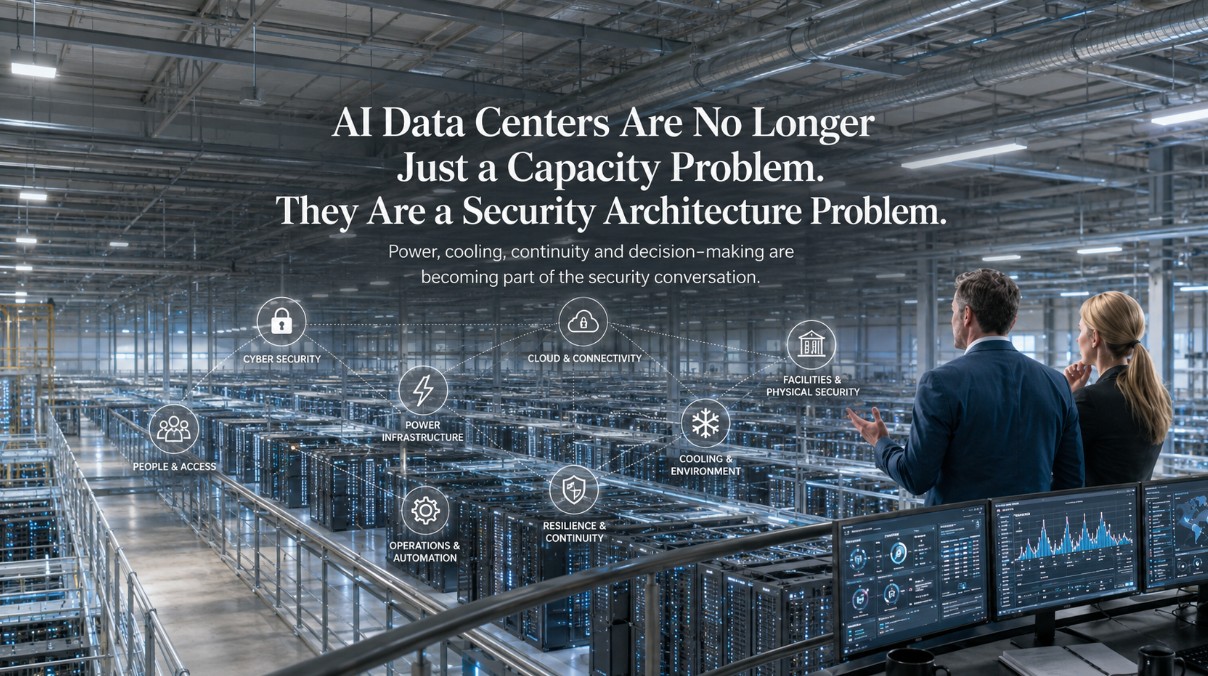
The data center industry now faces an unusual convergence of risks. Cyber threats continue to grow in sophistication. Physical threats are evolving beyond traditional trespassing or theft scenarios. Drone surveillance and unmanned systems introduce new vulnerabilities. Supply chain instability affects operational continuity. Nation-state tensions are increasingly influencing infrastructure security planning. AI growth is placing extraordinary strain on utility systems. Public perception and political pressure are becoming operational concerns rather than merely communications issues.
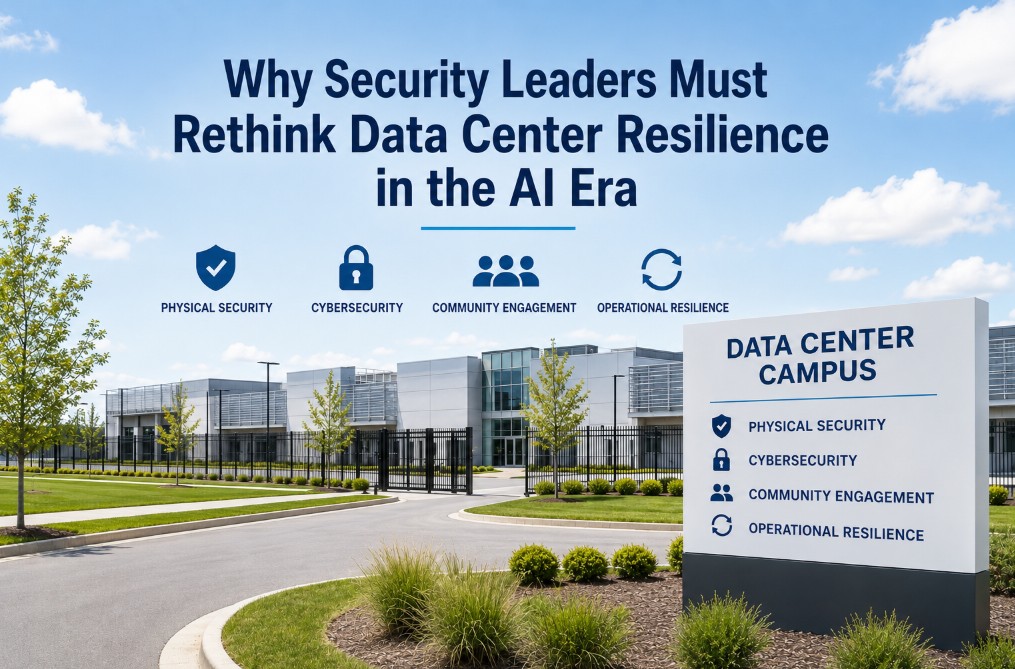
Security leaders therefore need to think more broadly about resilience than ever before. Traditional perimeter security remains essential, but the future of infrastructure protection will require far deeper integration between physical security, cybersecurity, operational governance, intelligence analysis, crisis communications, community engagement, and executive risk management. Organizations that continue treating physical security as an isolated function may struggle to adapt to the emerging threat environment.
This does not mean the industry should adopt alarmist narratives or assume widespread attacks are inevitable. Sabotage is not a certainty, nor is violence an unavoidable outcome. However, it would be irresponsible for operators, governments, and infrastructure leaders to ignore the warning signs developing around strategic infrastructure globally. The conditions driving instability are increasingly visible: geopolitical conflict, resource competition, economic anxiety, AI-driven disruption, declining institutional trust, and the symbolic politicization of technology infrastructure.
The conversation surrounding data center security is therefore entering a new phase. The industry is no longer discussing only uptime, access control, and compliance. It is now confronting larger questions tied to societal resilience, infrastructure legitimacy, operational continuity, and national stability in the age of artificial intelligence.
The challenge for security professionals moving forward will not simply be defending facilities. It will be understanding the broader ecosystem in which those facilities now exist.
References
Houpt, Mark A. “2026 and Beyond: Emerging Physical Risks to Data Centers.” DataBank, 2026.
Foundation for Defense of Democracies (FDD). “Geopolitical Conflict and the Expanding Risk to Cloud and AI Infrastructure.” FDD Analysis Report, 2026.
Euronews. “Middle East Conflict Raises Security Concerns for Data Center Infrastructure.” Euronews, 2026.
Oleastri, Luca. “Datacenter/AI Sabotage Planned for This Year (or Next).” LinkedIn post, 2026.
Y., Christopher. “Why Data Centers Are Becoming Targets, Even When They’re Approved.” Industry analysis referenced in LinkedIn discussion, 2026.