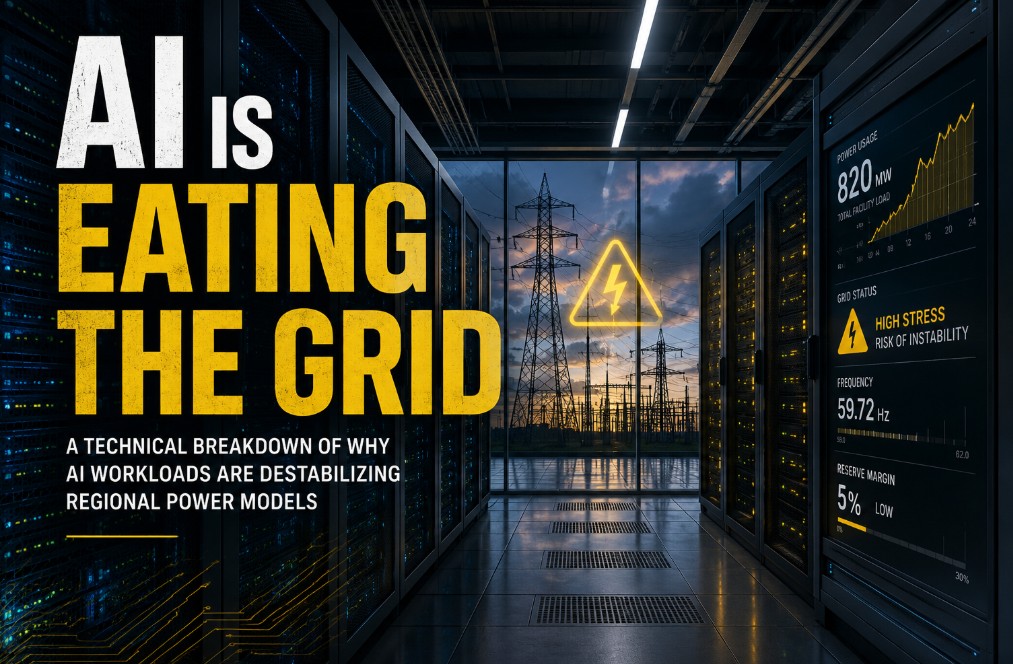
The artificial intelligence boom is rapidly transforming the modern data center from a passive consumer of electricity into one of the most aggressive and unpredictable loads ever placed on regional power infrastructure. Traditional enterprise data centers operated on relatively stable compute cycles with predictable cooling and power demands. AI infrastructure operates differently. Large-scale GPU clusters designed for model training and inference consume enormous amounts of electricity continuously, often at densities utilities were never designed to support. Hyperscale AI campuses now routinely request hundreds of megawatts of capacity, with some developments targeting gigawatt-scale growth that rivals small cities or industrial manufacturing regions. The result is a growing imbalance between digital infrastructure expansion and the physical limitations of the electrical grid. What began as a technology story has become a critical infrastructure and security issue.
The security implications of this shift are profound because the stability of the modern data center is directly tied to the reliability of external utility systems. In the past, most discussions about data center security focused on cyber threats, physical intrusion, or insider risk. Today, operators must increasingly focus on utility resilience, transmission vulnerabilities, substation security, fuel continuity, and regional power politics. As AI workloads continue to push power demand upward, utilities are struggling to expand generation, transmission, and distribution infrastructure quickly enough to keep pace. This creates conditions where rolling brownouts, delayed energization timelines, transformer shortages, and grid instability become operational security concerns rather than merely engineering challenges. The attack surface expands far beyond the walls of the facility and into the regional infrastructure ecosystem that supports it.
This growing dependency on power availability is reshaping site selection strategy across the industry. Historically, data center development focused heavily on tax incentives, fiber access, and favorable climates. Today, operators are increasingly prioritizing proximity to available generation capacity, substations, transmission corridors, water availability, and utility partnerships. In many regions, power availability has become the single largest gating factor for AI expansion. Some utilities are now warning that existing grids cannot support projected AI growth without massive infrastructure modernization efforts that may take a decade or longer. This creates both business risk and national security risk, particularly as hyperscale infrastructure becomes increasingly tied to economic competitiveness, government operations, defense systems, healthcare platforms, and financial markets.
The response from hyperscalers has introduced an entirely new layer of security complexity. Many are pursuing behind-the-meter generation strategies involving natural gas plants, battery energy storage systems, hydrogen, fuel cells, microgrids, and even discussions around small modular nuclear reactors. While these solutions may improve operational resilience, they also fundamentally alter the threat profile of the modern data center. Facilities that once resembled office infrastructure are beginning to resemble industrial energy campuses with critical utility assets onsite. This convergence between digital infrastructure and industrial power systems creates new risks involving operational technology security, sabotage, insider threats, drone surveillance, fuel supply disruptions, and attacks against supporting infrastructure.
At the same time, the rapid pace of AI infrastructure deployment is placing enormous pressure on design, construction, commissioning, and operational security practices. The race to deploy capacity has compressed timelines across the entire lifecycle of hyperscale development. Contractors, temporary workers, integrators, and vendors are moving through projects at unprecedented speed, often across multiple campuses simultaneously. Under these conditions, security governance can easily become fragmented. Physical security systems, OT environments, access control policies, commissioning procedures, and cyber protections may not mature at the same pace as construction. In many cases, the industry’s focus on speed-to-market is outpacing its ability to fully assess the long-term resilience implications of these facilities. The result is a growing risk that critical infrastructure is being deployed faster than it can be adequately secured.
The broader concern is that AI infrastructure is rapidly becoming part of national critical infrastructure. The modern data center now supports cloud services, military operations, AI model development, financial systems, communications platforms, healthcare environments, and increasingly, sovereign digital capabilities. As power demand escalates, the relationship between utilities, governments, and hyperscale operators will become one of the defining infrastructure challenges of the next decade. Security leaders must begin thinking beyond traditional perimeter defenses and adopt a true “grid-to-rack” security strategy that recognizes the interconnected nature of power, water, OT systems, cyber infrastructure, physical protection, and operational resilience. AI may be driving unprecedented innovation, but it is also exposing how fragile the underlying infrastructure ecosystem can become when digital growth exceeds the capacity of the physical world supporting it.
As I discuss throughout my book, Data Center Security: The Blueprint for Resilient Infrastructure, the modern data center must now be viewed as critical infrastructure where power, security, resilience, and operational continuity are inseparably connected. The AI boom is accelerating this reality faster than most regional utilities, operators, and governments anticipated.
www.DataCenterSecurityNews.net was created to track these emerging risks across the “grid-to-rack” continuum, bringing together intelligence on physical security, cyber risk, power infrastructure, operational technology, AI expansion, and critical infrastructure resilience shaping the future of the industry.
#DataCenterSecurity #AIInfrastructure #CriticalInfrastructure #GridToRack #PowerSecurity #Hyperscale #AI #CyberPhysical #DataCenters #OperationalTechnology #PhysicalSecurity #CyberSecurity #InfrastructureProtection #Resilience #OTSecurity #ESRM #Utilities #AIDataCenters #RiskManagement #MissionCritical #DigitalInfrastructure #EnergySecurity #CloudInfrastructure #CriticalSystems