The AI race is exposing something very basic, but still underestimated: artificial intelligence is not only a software story. It is also a physical infrastructure story. Behind every model, every enterprise AI deployment and every new cloud service, there is a real chain of power, cooling, land, construction, equipment, suppliers, access, people and operational decisions. The conversation may start with GPUs and compute, but it quickly ends up in very physical places: substations, cooling plants, delivery routes, server halls, construction sites, control rooms and security perimeters.
That is why the current pressure around AI data center capacity matters. The demand is growing, the commercial opportunity is clear, but the ability to deliver that demand depends on something far less flexible than software: physical capacity. Power availability, cooling requirements, grid access, permitting, construction timelines and specialized supply chains are becoming real bottlenecks. For security, this changes the conversation. When data centers become a bottleneck for AI delivery, they stop being only technical facilities. They become strategic infrastructure. And strategic infrastructure cannot be protected through isolated controls.
For years, data center security has often been discussed in separate categories: perimeter protection, access control, guards, CCTV, cyber controls, compliance, uptime, disaster recovery, vendor risk, visitor management, SOC procedures and incident response. All of those areas matter. But none of them are enough if they are treated as separate layers. The real question is not only whether each control exists. The real question is whether the whole environment can behave intelligently when pressure arrives.
This is where the industry needs to move from security controls to security architecture. A control solves a specific problem. An architecture defines how the full environment works together. In an AI-driven data center environment, it is not enough to ask whether there is a fence, a camera, an access badge, an alarm, a guard force or a monitoring tool. The better question is how those elements connect when something happens. Who sees the signal first? Who understands whether it matters? Who connects physical activity with operational impact? Who knows whether a supplier delay, a cooling issue, a power constraint or an access anomaly is routine noise or part of a wider risk pattern? Who has authority to escalate? Who decides when security, facilities, IT, operations, legal, compliance and leadership need to be in the same conversation?
That is the part that often gets underestimated. Modern data centers are becoming denser, more power-hungry and more dependent on specialized components, external suppliers and critical energy infrastructure. AI workloads increase that pressure. They require more energy, more cooling efficiency, tighter operational coordination and faster decision-making. This is not only an engineering challenge. It is a resilience challenge. And resilience is not simply the ability to keep systems running. It is the ability to make good decisions when the environment is changing, information is incomplete and pressure is increasing.
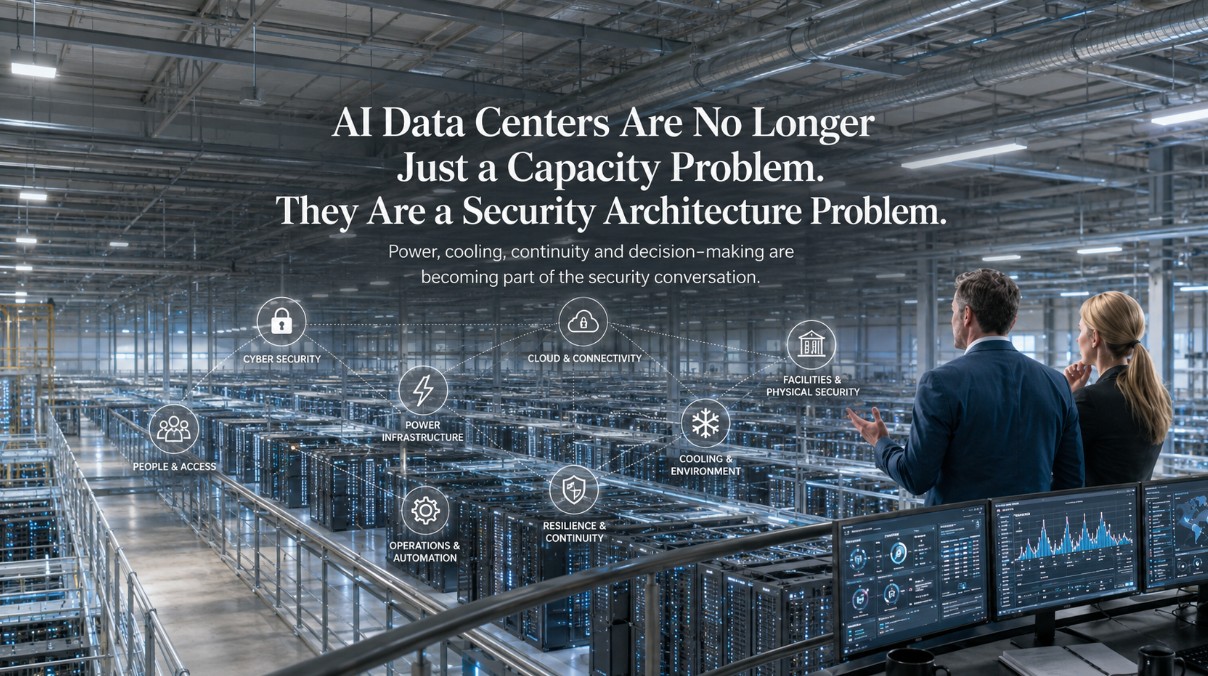
That is why security has to be connected much earlier to the rest of the business. Physical security cannot work separately from facilities. Facilities cannot work separately from power strategy. Power strategy cannot work separately from business continuity. Business continuity cannot work separately from cyber risk. Cyber risk cannot work separately from suppliers. And all of it eventually reaches leadership, because the consequences are no longer only technical.
In the AI data center world, a security failure may not only mean a breach. It could mean a disruption to capacity, a delay to deployment, a contractual problem, a regulatory issue, a reputational impact or a crisis that moves quickly across physical, digital and operational layers. The risk is not always dramatic at the beginning. Sometimes it starts with small weaknesses: poor coordination with contractors, rushed commissioning, weak temporary access procedures, unclear escalation paths, dependency on a single supplier, or security teams being brought in too late after key design and operational decisions have already been made.
That is why data center security needs to be involved from the beginning, not at the end of the project, not only when the building is ready, and not only when compliance asks for evidence. Security should be part of site selection, design, commissioning, supplier strategy, operational readiness, crisis planning and executive decision-making. It needs to understand which assets matter most, which areas are most critical, which third parties have access, which systems cannot fail and which decisions must be made quickly during an incident.
There is also an uncomfortable point the industry needs to keep in mind: adding more technology does not automatically create more control. More cameras, more sensors, more dashboards, more AI analytics and more alerts can help, but only if they are connected to decision-making. Otherwise, they can create more noise. A team can have visibility and still lack clarity. It can have data and still lack context. It can have alerts and still lack a clear operating model.
The future of data center security will not be defined only by who has the most advanced tools. It will be defined by who can connect signals, context, risk, people and response into a coherent operating model. That becomes even more important as AI infrastructure becomes tied to national competitiveness, cloud capacity, enterprise transformation, digital sovereignty and critical infrastructure resilience.
Security leaders need to widen the lens. The question is no longer only, “How do we protect the facility?” It is also, “How do we protect the continuity of AI infrastructure?” “How do we detect early signs of operational stress?” “How do we coordinate across departments before small issues become major incidents?” “How do we make decisions when physical infrastructure, cyber systems, suppliers, power constraints and business priorities collide?” “How do we keep human accountability clear when automation and AI become part of the operating environment?”
These are not theoretical questions. They are becoming daily operational questions. The AI boom is creating a new type of pressure on data centers: more demand, more density, more capital, more public attention, more dependency and more complexity. In that environment, security cannot remain a secondary layer. It has to become part of the architecture of resilience.
The next generation of AI data centers will need more than capacity. They will need security models designed around operational reality: pressure, interdependence, uncertainty, speed and human decision-making. Because the real challenge is not only how fast AI infrastructure can be built. It is how safely, intelligently and resiliently it can be operated once the pressure arrives.
Sources
Data Center Knowledge — Microsoft AI Surge Exposes Data Center Capacity Gap
https://www.datacenterknowledge.com/next-gen-data-centers/microsoft-ai-surge-exposes-data-center-capacity-gap
International Energy Agency — Energy and AI: Energy Demand from AI
https://www.iea.org/reports/energy-and-ai/energy-demand-from-ai
Deloitte — Can US Infrastructure Keep Up with the AI Economy?
https://www.deloitte.com/us/en/insights/industry/power-and-utilities/data-center-infrastructure-artificial-intelligence.html
Deloitte France — Data Centres: Turning Grid Constraints into a Lever for Europe’s Energy Transition
https://www.deloitte.com/fr/fr/services/consulting/perspectives/data-centres.html