In complex data center environments, incidents rarely belong to one team. The real risk appears when physical security, cyber, infrastructure, vendors, and operations all see part of the problem, but no one clearly owns the response.
Modern data centers are built around specialization. Physical security manages access, surveillance, perimeter protection, guards, visitor flows, credentials, and response procedures. Cybersecurity monitors networks, identities, systems, threats, and suspicious digital activity. Facilities teams are responsible for power, cooling, fire systems, maintenance, and infrastructure continuity. Operations teams focus on uptime, service delivery, vendor coordination, and customer impact.
Each function has its own tools, language, priorities, procedures, and escalation paths. On paper, this division of responsibility makes sense. In practice, many serious security problems do not remain inside one function. They emerge in the space between them.
An access anomaly may not be only a physical security issue. It may involve a vendor, a badge misuse pattern, a maintenance window, a camera blind spot, a network alert, and a facilities intervention happening at the same time. A suspicious contractor movement may not be only a guard force concern. It may connect to insider risk, cyber access, supply chain trust, asset protection, and operational continuity. A forced door, a failed authentication, a temporary outage, and an unusual network event may each look manageable in isolation. Together, they may indicate something more serious.
This is where the grey zone begins.
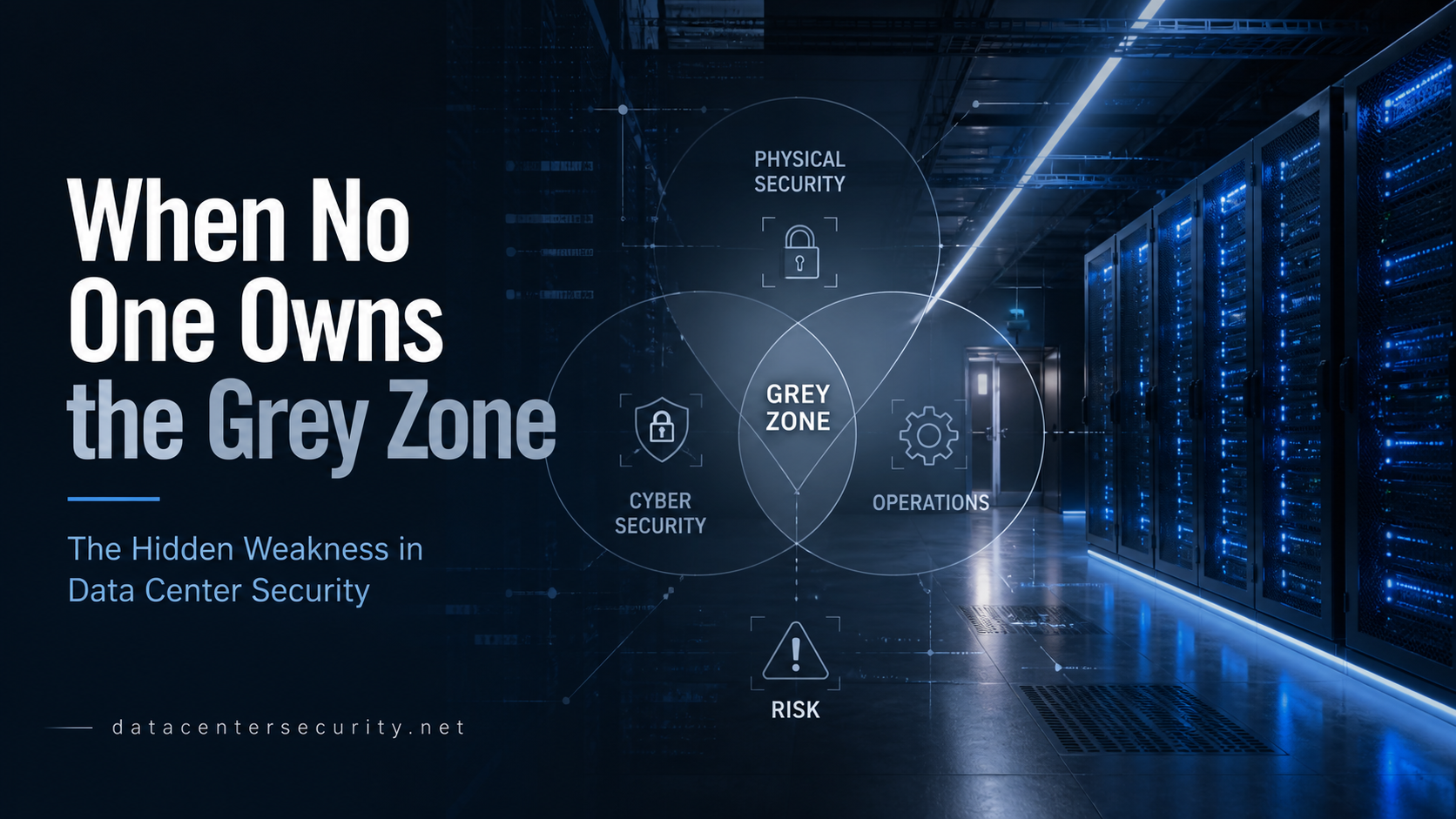
The grey zone is the area where an incident is not clearly owned by one department. It is not purely physical, purely cyber, purely operational, purely technical, or purely procedural. It is a combined event that requires interpretation across several domains. And this is where many security programs begin to weaken, not because controls are missing, but because ownership is unclear.
Adding more controls does not automatically solve unclear ownership. In some cases, it can make the problem harder to manage. More cameras, more sensors, more dashboards, more alerts, more procedures, and more escalation paths can create the appearance of control while increasing the number of people who hold only partial information. Everyone sees something. No one sees the whole picture. Everyone is responsible for a piece. No one clearly owns the response.
In a stable environment, this ambiguity may not be immediately visible. Teams can clarify slowly. They can send emails, review footage, check logs, call supervisors, ask vendors, and escalate through normal channels. But under pressure, ambiguity becomes expensive. Minutes matter. Information is incomplete. Teams hesitate. People stay within their formal scope. Nobody wants to overreact, and nobody wants to assume responsibility for something that sits outside their area. Meanwhile, the incident keeps moving.
This is why decision authority matters.
A mature data center security model should not only define what each team monitors. It should define who leads when an event crosses boundaries. Who has authority when physical and cyber indicators appear together? Who decides whether an operational anomaly should be treated as a security concern? Who coordinates vendors when their activity overlaps with a suspicious event? Who has the authority to pause, isolate, verify, deny access, escalate, or activate a crisis process when the situation is still unclear?
These questions are often more important than adding another layer of technology. The value of a security system is not only in detection. It is in the organization’s ability to understand what is happening and act coherently.
This is especially important in data centers because the environment is built around interdependence. A physical action can create cyber consequences. A cyber incident can affect physical operations. A facilities issue can trigger security concerns. A vendor process can introduce risk across several domains. A small communication failure can become a larger coordination failure.
The challenge, therefore, is not only to secure assets. It is to secure the relationships between systems, people, processes, and decisions.
That requires a different way of thinking. Instead of asking only whether a control exists, security leaders should also ask what happens after that control produces an ambiguous signal. Who interprets it? Who has the full picture? Who is allowed to decide? Who coordinates across functions? What happens when several teams are partially right, but no one is fully responsible?
These are not theoretical questions. They are operational questions.
A data center can have strong physical security, strong cyber monitoring, strong procedures, experienced teams, and advanced technology, yet still struggle if those elements do not come together under pressure. Security does not fail only when something is missing. Sometimes it fails because too many things are present, but not properly connected.
The next stage of data center security should focus less on isolated control maturity and more on operational clarity. That means defining decision authority before incidents happen. It means identifying grey zones in advance. It means testing not only whether systems detect events, but whether teams can interpret and act on them together. It means designing escalation paths that reflect real complexity, not just organizational charts.
In modern data centers, security must become an architecture of coordination.
Because the most important question may not be whether the system detected the event.
The more important question may be whether, once it did, anyone clearly owned the decision.