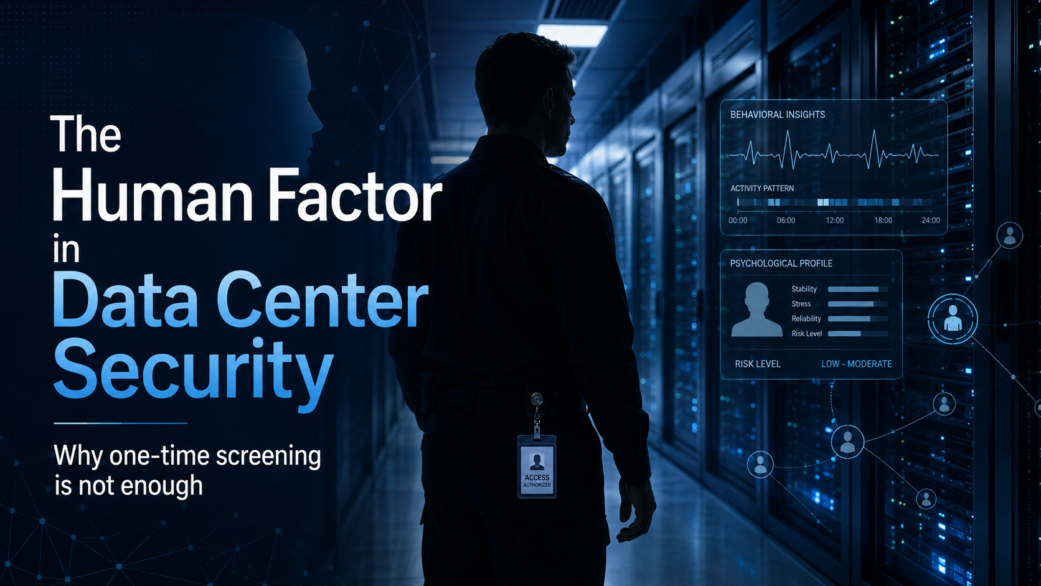
Data center security often focuses on the visible layers of protection: perimeter controls, access systems, surveillance, biometrics, mantraps, vendor procedures, cyber monitoring and incident response protocols. These elements are essential, but they can create a dangerous assumption: that once a person has been vetted, trained and authorized, the human risk has been solved. It has not. In critical infrastructure, the human factor is not only an HR concern; it is a security architecture issue.
A psychological assessment at the beginning of employment may be useful. Background checks, onboarding procedures and initial training are also important. But they are not continuous controls. A person can enter an organization stable, motivated and compliant, and months later be operating under financial pressure, fatigue, personal stress, resentment, burnout, coercion, disengagement or emotional instability. In a normal business environment, that may create performance issues. In a data center, it can become a critical security exposure.
The issue is not that people are inherently untrustworthy. The issue is that people are dynamic, while many security models still treat human risk as if it were fixed at the point of hiring. A guard, technician, contractor, supervisor or operations employee with access to restricted areas can influence the security posture in ways that no dashboard may immediately detect. They can open a door, ignore an anomaly, share sensitive operational details, fail to challenge a contractor, bypass a procedure, disable a routine check or make a poor decision at the wrong moment. Not always through malicious intent. Sometimes through pressure, distraction, fatigue or impaired judgment.
This is where I think many security programs create a blind spot. Human risk is often divided between departments. HR manages wellbeing, contracts and disciplinary matters. Security manages access control and physical protection. Operations manages continuity and service delivery. Legal and compliance manage policy and liability. But the risk itself does not respect those internal boundaries. In a data center, a human vulnerability can become an access vulnerability, an operational vulnerability, a reputational vulnerability and a business continuity issue at the same time.
This is where security architecture has to go beyond physical design. It is not enough to define walls, cameras, doors, zones and procedures. The architecture must also define how human risk is observed, escalated, supported and controlled without turning the workplace into an environment of suspicion. That balance matters. The objective is not to punish people for having problems. The objective is to prevent unmanaged human vulnerability from becoming unmanaged operational risk.
A stronger model would include continuous access review, separation of duties, supervisory observation, fatigue awareness, behavioral indicators, clear escalation channels, support mechanisms, vendor oversight, role rotation where appropriate and defined protocols for when concerns arise. It would also require real collaboration between security leadership, HR, operations, legal and executive management. If a supervisor notices a significant behavioral change, if HR is aware of serious pressure, if access control shows unusual patterns, or if operations detects repeated procedural deviations, those signals should not remain isolated. They should feed into a responsible, proportionate and well-governed security process.
This does not mean intrusive surveillance. It means mature governance. There is a major difference between spying on employees and designing a system that can detect early warning signs, support people before they break under pressure and protect the organization before a vulnerability becomes an incident. In critical environments, mental health, fatigue, motivation, internal culture and personal pressure are not only welfare topics. They can become security variables.
Data centers are built around resilience: redundant power, cooling, connectivity, failover systems, cyber defenses and physical protection layers. But human resilience is often less structured. A facility can have redundant power and still depend on a tired person making the right decision at 3 a.m. It can have advanced access control and still fail if a trusted insider misuses authority, ignores a procedure or allows someone through because they are under pressure. It can have a strong security design and still remain exposed if the people operating it are not continuously understood, supported and supervised.
The next generation of data center security should not separate human factors from technical protection. It should integrate them. Insider risk is not only the malicious insider. It is also the overlooked insider, the pressured insider, the fatigued insider, the unsupported insider and the trusted insider whose access was never re-evaluated after their circumstances changed.
Trust is necessary in any security environment. But trust without continuous governance is not resilience. It is exposure.
The future of data center security will not be defined only by better technology, stronger doors, smarter cameras or more advanced monitoring platforms. It will also be defined by whether organizations understand that the people operating, guarding, maintaining and supervising the environment are part of the protection system itself. If the human factor is treated as a static HR matter, the architecture remains incomplete. If it is treated as a dynamic security variable, the organization becomes harder to compromise, easier to govern and better prepared to respond when pressure appears.