Data Center Security News, based on a LinkedIn post by Jonathan Cheng, Chief Executive Officer at Volterra, “Driving Strategic Partnerships.”
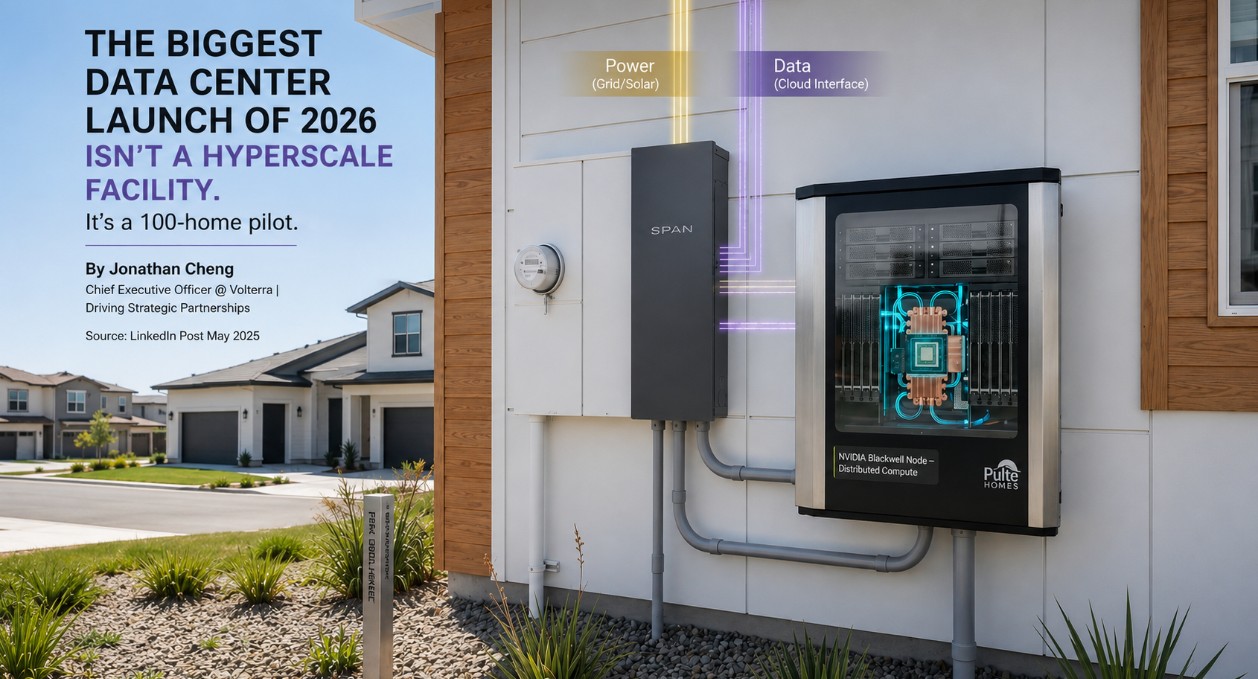
The biggest data center story of 2026 may not be a hyperscale campus. It may be a 100-home pilot.
Jonathan Cheng recently pointed to a development that deserves more attention from the infrastructure and security community: PulteGroup, NVIDIA, and SPAN are testing a model that places fractional AI data center nodes on or near newly constructed homes. The concept is called XFRA, and SPAN describes it as a distributed data center platform built from residential and small commercial compute nodes designed to close the “speed-to-power” gap now slowing AI infrastructure development. SPAN says the system will launch with enterprise-grade, liquid-cooled NVIDIA RTX PRO 6000 Blackwell Server Edition GPUs.
The idea is simple, but the implications are significant. Instead of waiting years for land, substations, transmission upgrades, interconnection approvals, and large-scale construction, XFRA attempts to use electrical capacity that already exists at the grid edge. SPAN’s smart panel technology identifies unused electrical headroom in homes and small commercial buildings, then uses that capacity to power compact AI compute nodes. SPAN has said this approach could support AI inference, cloud gaming, and other distributed workloads that need lower latency and faster deployment than traditional data center development can often provide.
Several public reports describe the residential node as a compact exterior unit installed near typical home infrastructure such as HVAC equipment, electrical panels, battery backup, and sometimes solar. Realtor.com reported that SPAN told CNBC it could install 8,000 XFRA units about six times faster and at five times lower cost than building a comparable centralized 100MW data center. TechRadar reported that each unit may contain sixteen NVIDIA RTX Pro GPUs and that SPAN has discussed a 100-home pilot in 2026, with a larger ambition of scaling to 80,000 units.
For homeowners, the value proposition is lower operating cost, subsidized or free electricity and internet, or some form of recurring compensation. For builders, it introduces a new infrastructure layer inside residential development. For AI cloud providers, the pitch is that these distributed nodes can be consumed like a traditional data center resource, but without concentrating every megawatt into one politically sensitive, utility-constrained site. PulteGroup has described the opportunity as one that could help offset homeowner energy costs while potentially reducing pressure on local infrastructure if the technology proves out.
This is not a crypto-mining-at-home rerun. The important difference is the alignment of a major AI hardware company, a national homebuilder, and an energy technology platform around inference workloads rather than speculative mining. Training large models still belongs in hyperscale environments where thousands of GPUs must operate in close coordination. But inference is different. Inference is increasingly distributed, latency-sensitive, and tied to where users, devices, agents, and applications actually operate.
That is why this story matters to data center security. Residential micro-data centers do not replace hyperscale campuses. They expand the definition of data center infrastructure. They push compute into neighborhoods, onto exterior walls, into builder specifications, onto residential electrical systems, and into jurisdictions that may have no mature framework for securing, inspecting, permitting, or responding to AI infrastructure at this scale.
The industry is now separating into three layers. Hyperscale remains the core for training, large model serving, and dense GPU clusters. Residential micro-nodes may become a new layer for consumer inference, lightweight agentic workloads, and latency-sensitive augmentation. Between the two sits the edge: 1–10 MW deployments on telecom campuses, commercial real estate, industrial properties, and regional infrastructure sites designed for enterprise-grade inference and reasoning workloads.
The middle layer may be where much of the strategic margin lives. It is too large for residential deployment, too distributed for hyperscale economics, and exactly where enterprise inference, compliance, latency, resilience, and security governance begin to collide.
The security questions are immediate. Who owns the physical security of a GPU box mounted outside a house? What happens when a residential neighborhood becomes part of an AI compute network? How are theft, tampering, fire response, utility coordination, network access, privacy, homeowner liability, and local permitting handled? TechRadar noted that experts have already raised concerns about local grid management, regulatory approval, homeowner acceptance, and the security risk of expensive GPU equipment located in residential environments.
This is the real lesson from Jonathan Cheng’s post: the future of data center infrastructure is not only bigger campuses. It is also smaller, faster, distributed, and embedded into places the industry has not historically treated as data centers.
If compute cannot be distributed, it may not be deliverable at the scale AI now demands.