
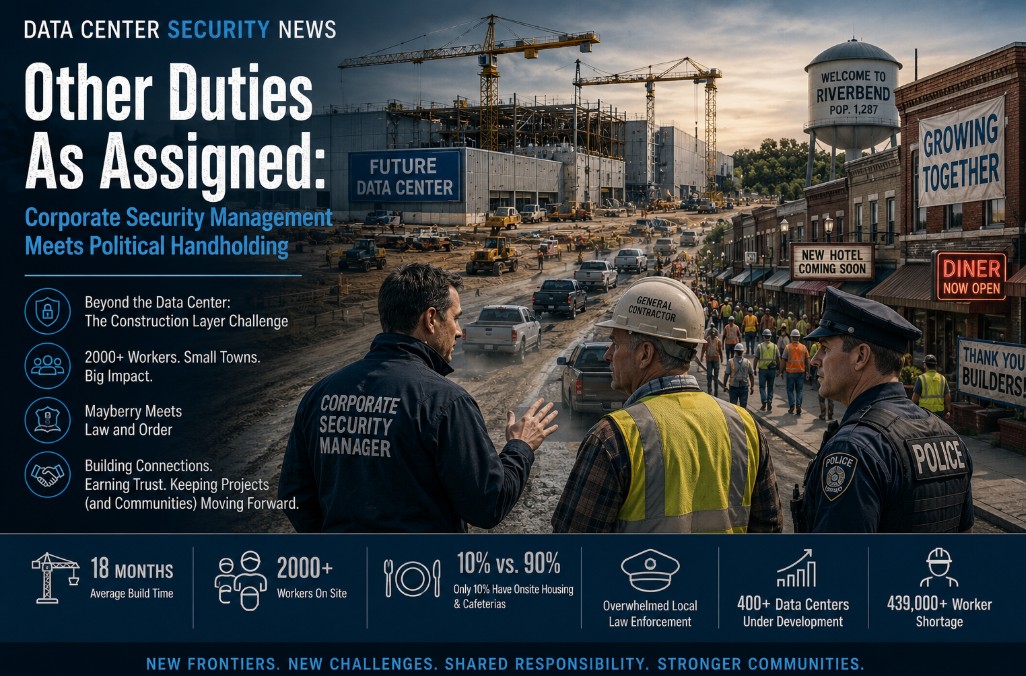
The datacenter boom that is being experienced has challenged many traditional security operations, but not for traditional reasons.
Traditional data center security has defined layers with specific controls implemented in each layer. Perimeter, public space, internal space, and restricted space; each with its own design and process for movement throughout the layer.
Herein lies a new problem that datacenter security must now deal with. The construction layer. In the past, security management has been involved during the design phase for technology approval, implementation for “ready for service” (RFS) dates before the tenant moves in, and then operationally once RFS is met. The general contractor (GC) typically handles all site security and on-site contractors. Datacenter security management is typically not involved or not heavily involved during the construction phase; however, that seems to be changing. Security is now being brought in to help with public relations between the local police or sheriff’s department and the GC’s workforce. Not to handle the security, but to handle the local political backlash of the data center build.
Remember the key statement in every job description? Other duties as assigned.
An average data center takes 18 months to build. The workforce surges to an excess of 2000 workers. New data centers are being built at the convergence of where land can be acquired and where power generation capable of meeting the need is available. Not even where internet service providers (ISPs) are located. Need those? The mindset is those can be brought in. The problem is, these locations of convergence are finding datacenters being located in small, rural townships with minimal population. Even more minimal are roads, hotels, and restaurants. I worked with one data center that originally had only three food options: pizza in one gas station, Subway in the other gas station, or a diner.
Only 10% of construction projects have workforce camps that include modular housing and onsite cafeterias. The other 90% has those 2000+ workers arriving to work each day, leaving the site each day for a meal, or at quitting time. The local police departments, all along the commute path, with maybe two officers on per any given shift, are now overwhelmed. Small town living has turned into a minor metropolitan city overnight, and with it came all of the problems. What had been small town policing, where the officer knew everyone in town and had minimal negative interaction with the townspeople, is now faced with traffic jams, acts of speeding, vehicle crashes in extreme weather, bar fights, and more. It’s as if Andy Griffith’s Mayberry meets Law and Order.
The data center company and the GC should be working together to reduce incidents like these. Some are, many are not. Either way, many times the data center’s corporate security management is leveraged because senior security management typically has some connection to a federal, state, or local law enforcement agency in their past. The ask: play politics to keep the local law enforcement happy while data center construction continues or even expands.
This trend is not going away anytime soon, either by the looks of it. According to a Wall Street Journal article, “Data Centers Are a ‘Gold Rush’ for Construction Workers,” November 29t, 2025, there are “more than 400 data centers currently under development”, which is causing “the construction industry is
facing a shortage of roughly 439,000 workers”. What this means is that fewer workers means longer hours, and a higher likelihood of exhaustion, which leads to more small-town mischief. However, just like the olden days of the gold rush, these small towns are now becoming an entrepreneur frontier, where restaurants, hotels, and businesses that cater to the construction workforce are popping up. These small rural townships are growing, whether they want to or not.