As data centers grow in scale and interdependence, a common assumption emerges: more controls will solve the problem. More monitoring, more procedures, more escalation paths. At a certain level, this works. Each layer adds structure and improves visibility. But as environments become more complex, something changes. Security stops being a control problem and becomes a complexity problem.
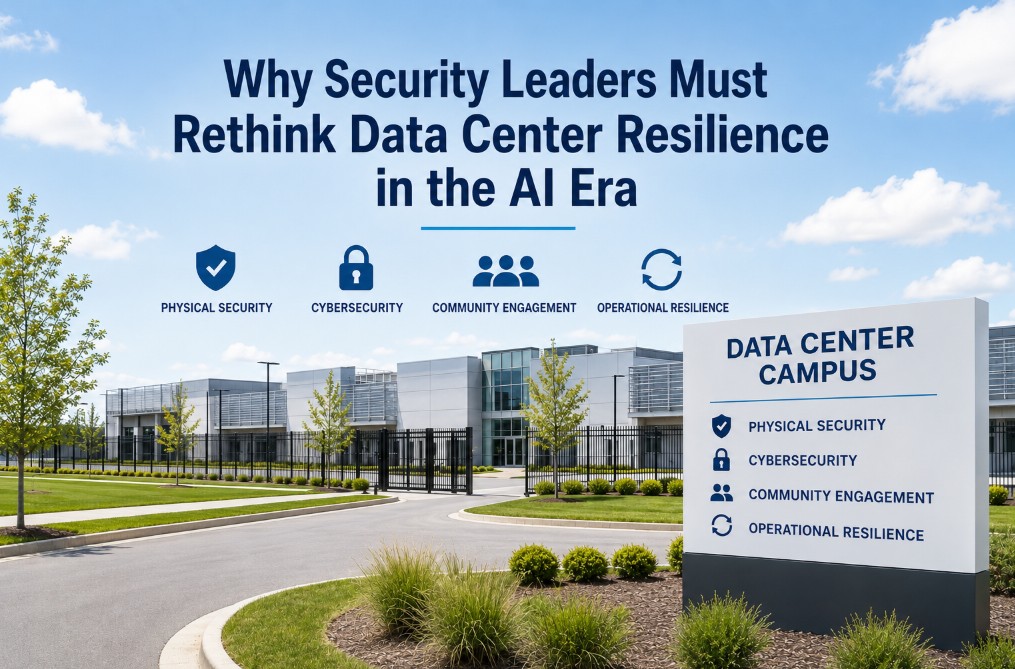
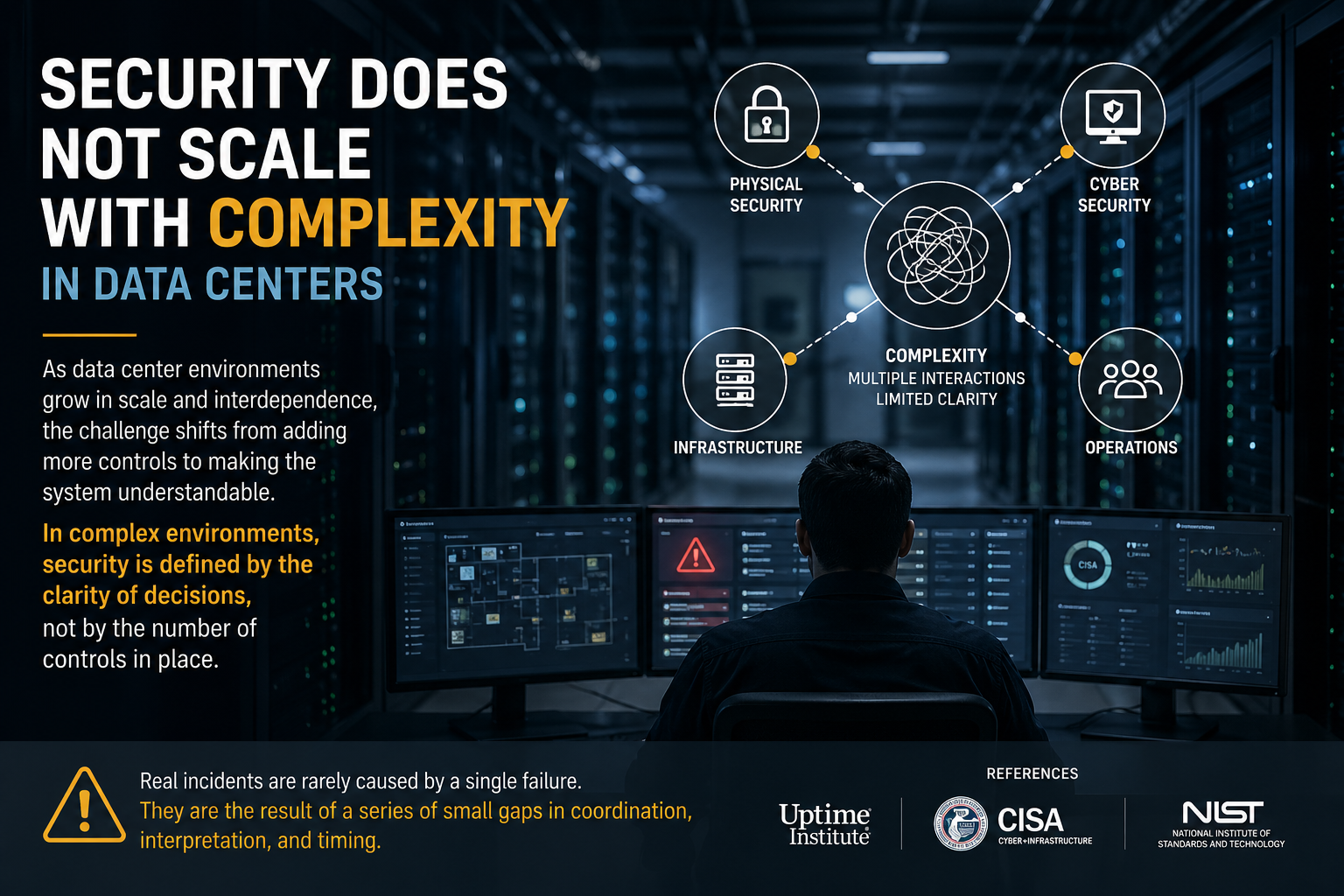
In modern data centers, physical security, cybersecurity, infrastructure, and operations are tightly connected. An access event can affect operations, a network delay can impact monitoring, and a maintenance activity can introduce unexpected risk conditions. Nothing is truly isolated, and that is where the system starts to behave differently from how it was originally designed.
This growing interdependence is well documented. The Uptime Institute has consistently pointed out that while infrastructure resilience has improved, operational complexity remains one of the main drivers of incidents. In parallel, CISA highlights how physical and cyber environments are increasingly converging, making it harder to isolate events within a single domain.
Real incidents reflect this pattern. In several major outages analyzed by the Uptime Institute, failures were not caused by a single technical issue, but by a sequence of interacting conditions, including delayed responses, misinterpretation of alerts, and coordination gaps between teams.
Imagine a routine maintenance window where a vendor access issue, a delayed system notification, and a separate infrastructure alert happen within the same short period. None of these events may be critical on their own. But together, they create uncertainty. Teams begin working from partial views, priorities become less clear, and the situation becomes harder to interpret.
That is usually where the real challenge begins. Events overlap, signals compete for attention, and teams act based on different parts of the picture. At that point, the issue is no longer just detecting what is happening, but understanding what actually matters.
Organizations often respond by adding more controls. More alerts, more checks, more layers. This creates a sense of increased security. In practice, it can also increase noise, slow down interpretation, and make coordination harder. The NIST reflects this shift in its frameworks, where governance and decision-making are treated as critical components of security, not just technical controls.
The system does not fail because a control is missing. It degrades because the organization cannot maintain a coherent picture across all moving parts. Small delays, conflicting signals, and unclear ownership are each manageable on their own, but together they reduce the system’s ability to respond effectively.
This is why security in data centers does not scale linearly with complexity. Adding more controls does not necessarily make the system stronger. It can make it harder to operate.
As data centers continue to grow in scale and criticality, the challenge is shifting from building stronger systems to making them understandable. In complex environments, security is not defined by the number of controls in place, but by the clarity of decisions across them.
That is why complexity cannot be solved only by adding more layers. It has to be managed through coordination, interpretation, and decision-making.