As AI workloads increase density, automation and infrastructure dependency, data center security must evolve from isolated controls to integrated operational decision-making.
Data center security has traditionally been divided into two main areas: physical security and cybersecurity. Physical security protected the perimeter, the building, the access points, the cages, the racks and the movement of people inside controlled areas. Cybersecurity protected networks, identities, systems, workloads and data. For many years, that separation was logical. In today’s environment, especially with the rise of AI data centers, it is becoming increasingly insufficient.
AI data centers are not simply larger versions of traditional facilities. They are denser, more energy intensive, more automated and more dependent on the continuous performance of power, cooling, building systems, operational technology and external utilities. This changes the nature of security. The question is no longer only whether someone can gain unauthorized access or whether a system can be attacked digitally. The deeper question is whether the organization can understand how physical, cyber, technical and operational signals may combine into a threat to continuity.
A cooling anomaly may not appear to be a security event by itself. A vendor remote access session may seem routine. An unusual badge access pattern may be easy to dismiss. A power fluctuation may be treated as a facilities issue. A change in a building management system may be seen as a technical adjustment. But when these signals appear together, in the wrong sequence or at the wrong time, they may indicate something much more significant.
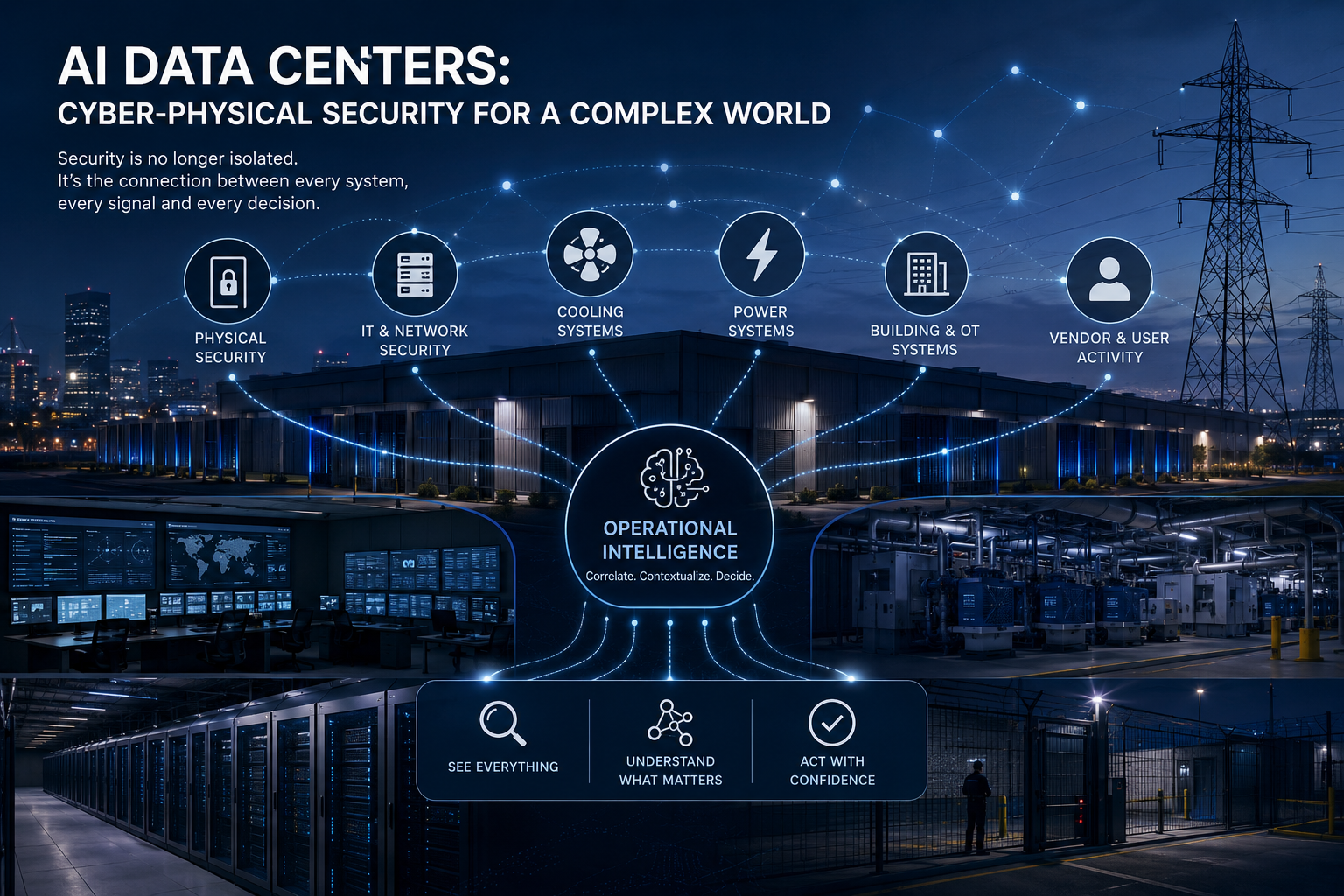
This is where data center security needs to evolve. The modern data center is becoming a cyber-physical security environment. Energy systems, cooling systems, BMS, DCIM, EPMS, access control, CCTV, network telemetry, vendor activity and human decision-making are no longer separate concerns. They are part of the same operational picture.
The challenge is that most organizations are still structured in silos. The security team sees access control, surveillance and physical incidents. The facilities team sees power, cooling, alarms and environmental performance. The cyber team sees logs, identities, sessions and network activity. The operations team sees service impact and business continuity. Each team may be looking at valid information, but the incident itself does not respect those internal boundaries.
For AI data centers, this matters even more. Higher rack densities reduce the margin for delay. Greater automation increases dependency on control systems. More third-party involvement creates more access complexity. Power and cooling performance become more directly tied to availability. As the infrastructure becomes more critical, the consequences of fragmented visibility become greater.
The next generation of data center security will not be defined only by stronger gates, better cameras or additional cybersecurity tools. Those controls remain essential, but they are not enough by themselves. The real value will come from the ability to connect signals, interpret context and support timely decisions before a technical deviation becomes an operational disruption.
This does not mean removing humans from the decision-making process. It means giving them a clearer operating picture. In high-pressure environments, the problem is rarely a lack of data. Data centers already generate enormous amounts of information through sensors, cameras, access systems, alarms, dashboards, logs and operational platforms. The real problem is knowing what matters, when it matters and who needs to act.
A mature security architecture for AI data centers should be able to answer three questions continuously: what is happening across the environment, how these signals relate to each other, and what decision should be made now to protect continuity, safety and resilience. This is where security moves from being a collection of individual controls to becoming a decision architecture.
As AI infrastructure continues to expand, data centers will face greater pressure from power availability, grid dependency, cooling demands, supply chain exposure, vendor complexity and regulatory scrutiny. Security leaders will need to think less in isolated categories and more in systems. A physical event can create cyber consequences. A cyber event can produce physical impact. A vendor action can become a risk multiplier. An operational anomaly can become an early warning signal.
The security question is changing. It is no longer only, “Can someone get in?” It is also, “Can we understand how physical, cyber, technical and operational signals may combine to threaten continuity?” For AI data centers, that may become one of the most important security questions of the next decade.