Most data center security environments do not fail because something is missing, but because at some point everything starts happening at once. Access control triggers, a maintenance activity overlaps, a cyber alert comes in, and operations needs continuity. Individually, none of these are critical. Together, they create friction, and that is where the system starts to struggle.
On paper, everything works. Controls are in place, layers are well designed, and the technology is solid. But real environments do not operate on paper. Physical security depends on network availability, operators depend on context, and decisions depend on timing. Nothing really happens in isolation.
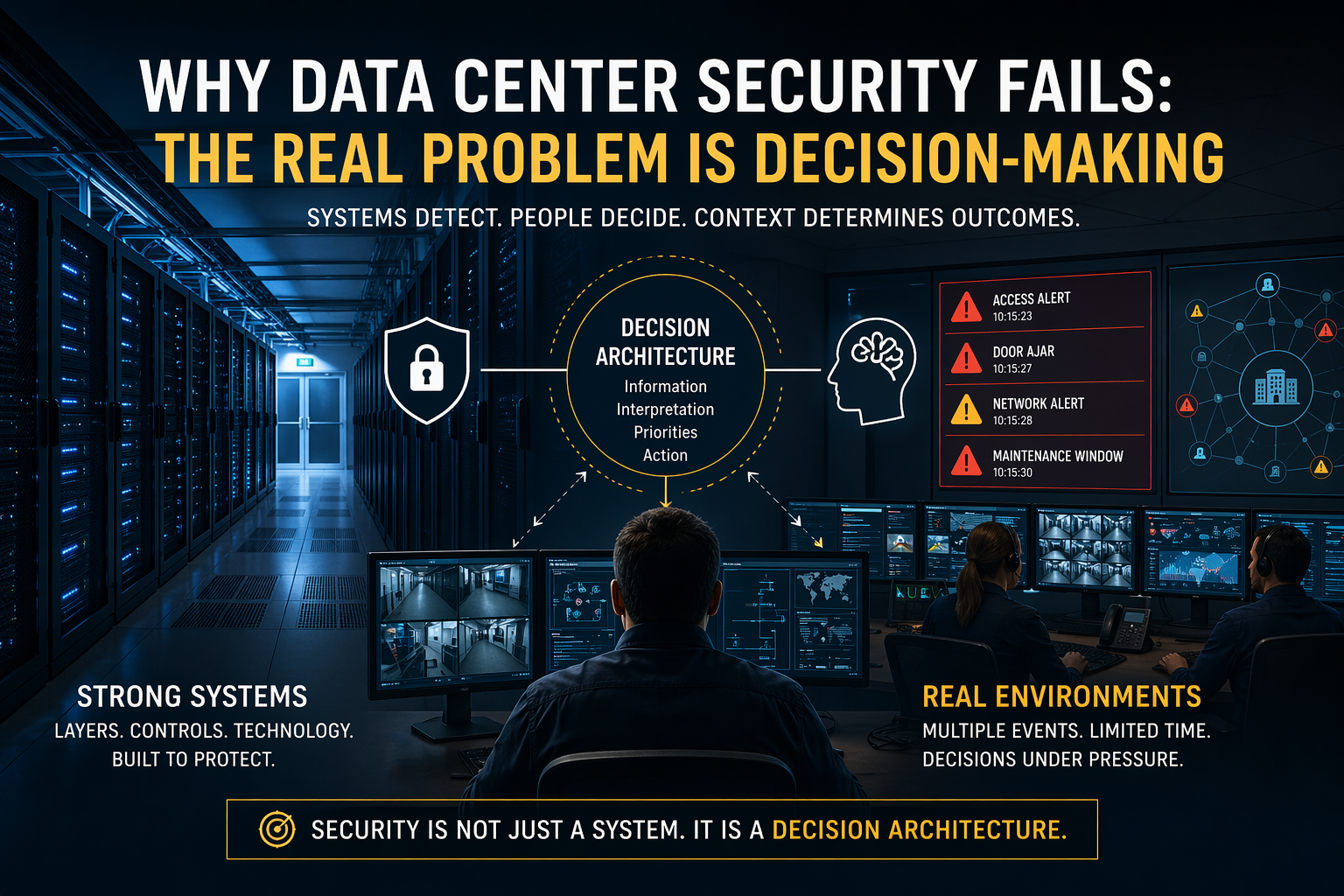
Imagine a routine maintenance window. A contractor badge does not behave as expected, a door remains open slightly longer than normal, an operator receives a video alarm, and IT is already dealing with a separate network alert. None of these events alone may justify escalation. But together, they create uncertainty. The question is no longer whether each control works. The question is whether the organization can understand the combined situation fast enough to act correctly.
Organizations often rely on layered security to reduce risk, and it does help. It slows processes, creates redundancy, and adds resilience. However, layers do not make decisions. They do not tell you what matters when several alerts occur at the same time, they do not clarify ownership, and they do not resolve conflicting signals.
Most systems are very effective at detecting events, but they are far less effective at helping people understand them, especially under pressure. This is where the problem truly lies. Not in the controls or in the design, but in how decisions are made when the situation does not match the expected model.
This is where the concept of decision architecture becomes relevant. Not as another framework or tool, but as a way to understand what actually happens inside the system. It looks at how information moves, how signals are interpreted, how priorities are set, and who acts when things are unclear. In practice, that is what determines whether security holds or breaks.
Data centers are a clear example of this shift. They are no longer isolated facilities, but highly interdependent environments where security, operations, and uptime are tightly connected. According to the Uptime Institute, although infrastructure resilience has improved significantly, operational complexity remains a major source of risk. In parallel, CISA has emphasized the growing convergence between physical and cyber security. NIST also highlights through its risk and cybersecurity frameworks that security effectiveness depends not only on technical controls, but also on governance, coordination, and decision-making.
All of this points in the same direction. The challenge is no longer limited to building strong systems, but extends to ensuring that organizations can interpret what is happening and respond coherently when situations become complex.
When pressure increases, teams rarely fail due to a lack of tools. They struggle because reality does not align with how those tools were designed to be used. Physical security reacts to one issue, IT to another, and operations tries to maintain continuity. Individually, each response may be correct, yet collectively the situation can still break down.
This is where the gap appears.
Security, in that sense, is not about adding more controls, but about how decisions are made across them. It depends on how information is shared, how priorities are aligned, and how action is coordinated. In environments where everything is interconnected and timing is critical, that distinction becomes essential.
Security rarely fails at the control level. It fails where interpretation and decision cannot keep pace with reality.
That is why security is not just a system. It is a decision architecture.