Data centers have become extraordinarily sophisticated environments. Physical security, cybersecurity, access control, video surveillance, operational technology, facilities management and, increasingly, AI-driven analytics all contribute to protecting critical infrastructure. Yet there is still something I believe we do not discuss enough: much of the security architecture protecting these environments remains relatively static, even though the data center itself is anything but static.
Conditions change constantly. Contractors arrive, maintenance begins, systems are taken offline, redundancy is reduced and access permissions temporarily change. Power or cooling conditions fluctuate, external threat levels evolve and a communications failure can suddenly make another protective layer far more important than it was an hour earlier. The building may be the same, but the risk is not. Yet in many environments, the security posture remains largely unchanged until a specific alarm or incident forces a reaction. This is where I believe the industry still has work to do.
From integration to architectur
Traditional security systems are very good at telling us that something happened. A door opened, a credential failed, a camera detected movement, a device stopped communicating or a temperature threshold was exceeded. That information matters, of course, but in a complex environment the more important question is often not what happened. It is what that event means at that particular moment. A failed credential at 10:00 on a normal working day may be little more than an administrative issue. The same event at 02:00, during critical maintenance, while another system is degraded and unusual activity is taking place in a nearby area, deserves a very different interpretation.
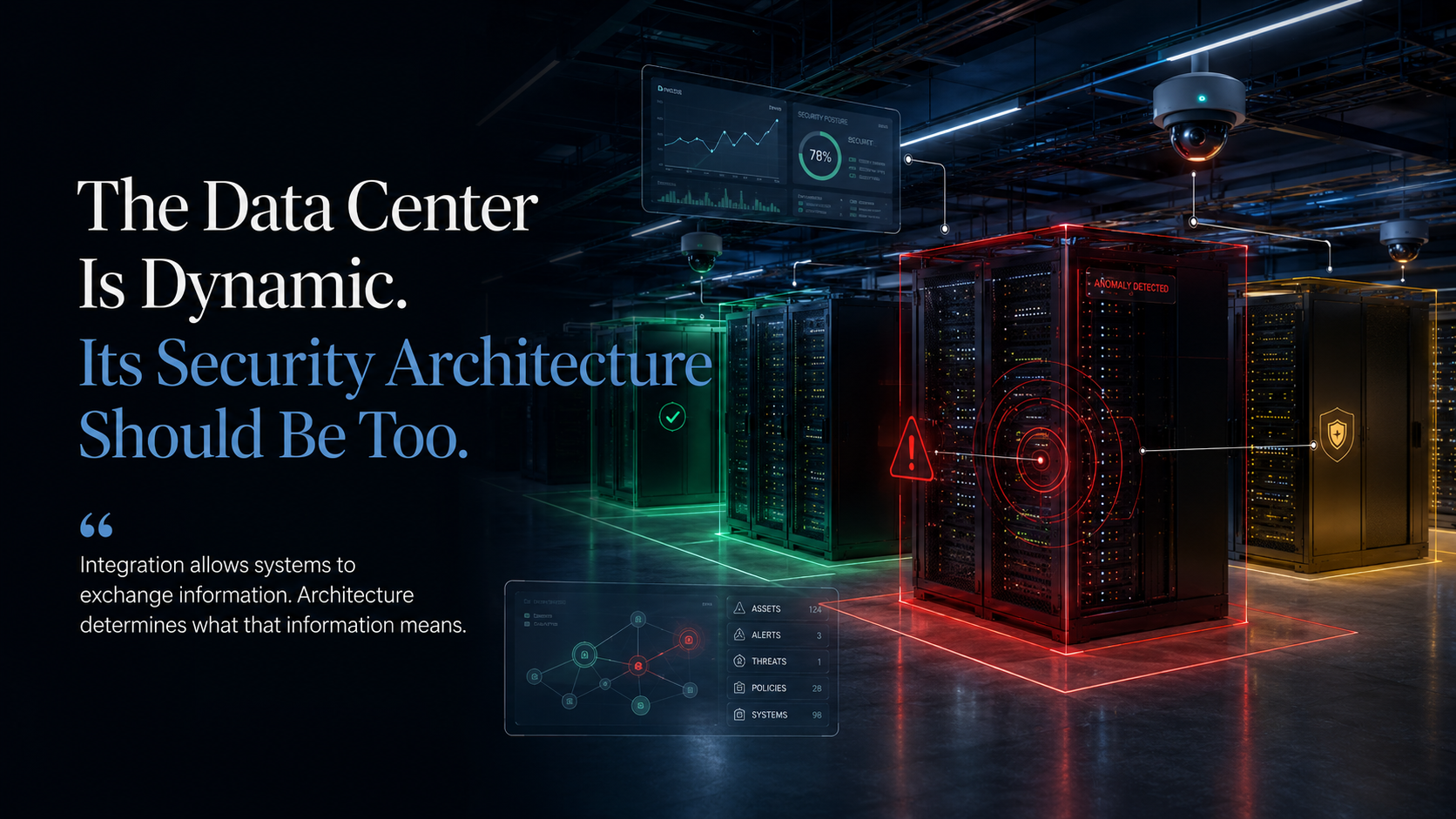
This is why I see an important difference between integration and architecture. Integration allows systems to exchange information. Architecture determines what that information means. We have made enormous progress in connecting systems. Access control can trigger video, building systems can expose telemetry, cybersecurity platforms can ingest multiple sources and physical security events can be sent to a security operations center.
However, putting more information in front of an operator does not necessarily create better situational awareness. Sometimes it simply creates more information. As the number of sensors, platforms and analytics grows, the real bottleneck can move from detection to interpretation. The operator then has to decide whether ten alerts represent ten unrelated events or ten pieces of the same developing situation. That is a very different problem.
Security posture should respond to context
The next step, in my view, is to think less about isolated alarms and more about the operational state of the environment as a whole. Where did the event occur? What depends on that area? Who is involved? What else is happening at the same time? Is the facility operating normally? Has redundancy been reduced? Are other systems showing unusual behavior? Context changes the meaning of information.
If the context changes sufficiently, perhaps the protective posture should change with it. That could mean increasing monitoring around a temporarily critical area, applying additional verification, modifying escalation thresholds or directing more operator attention toward a developing situation. It does not necessarily mean giving autonomous systems unrestricted authority. I would argue almost the opposite.
Human judgment, degraded conditions and explainability
The objective should be to help the human operator make better decisions by reducing the time spent manually reconstructing what is happening. Machines are becoming very good at collecting signals, identifying relationships and maintaining context across large volumes of information. Human judgment remains essential when decisions involve uncertainty, proportionality, accountability and consequences that cannot be reduced to a simple rule. The best architecture should allow each to do what it does best.
There is another aspect that deserves greater attention: degraded conditions. Security systems fail too. A camera feed can disappear, a network can go down, an integration can stop working, data can become incomplete and a sensor can produce unreliable information. A genuinely resilient security architecture should understand not only the condition of the environment it protects, but also the condition of its own protective capabilities.
If one source of information disappears, uncertainty has increased. If one detection layer is unavailable, another may become more important. If automation can no longer be trusted, there must be a clear mechanism for returning decision authority to the operator.
That is part of resilience as well.
The same applies to explainability. If a system recommends increasing the protection level of a particular area, the operator should understand why. If several apparently unrelated events are being treated as part of the same situation, that relationship should be visible. The more intelligence and automation we introduce into critical infrastructure, the more important it becomes to understand how conclusions are being reached.
Security architecture cannot stop at commissioning
The industry is right to focus on security from the earliest stages of site selection, design, construction and commissioning. Good security architecture must begin there, but it should not end there. Once a facility becomes operational, its architecture has to live with the reality of constantly changing conditions. The question is no longer only whether the right controls were installed, but whether those controls can work together intelligently when the environment no longer resembles the one for which the original security plan was designed.
Can the architecture recognize that the context has changed? Can it understand that several minor anomalies may matter more together than they do individually? Can it help an operator identify a developing situation before it becomes an obvious incident? That, to me, is where the next evolution of data center security begins.
The data center is already dynamic. Its security architecture should be too.